A summery "The Bail Project’s Own Data Undermines Its Taxpayer-Savings Claim"
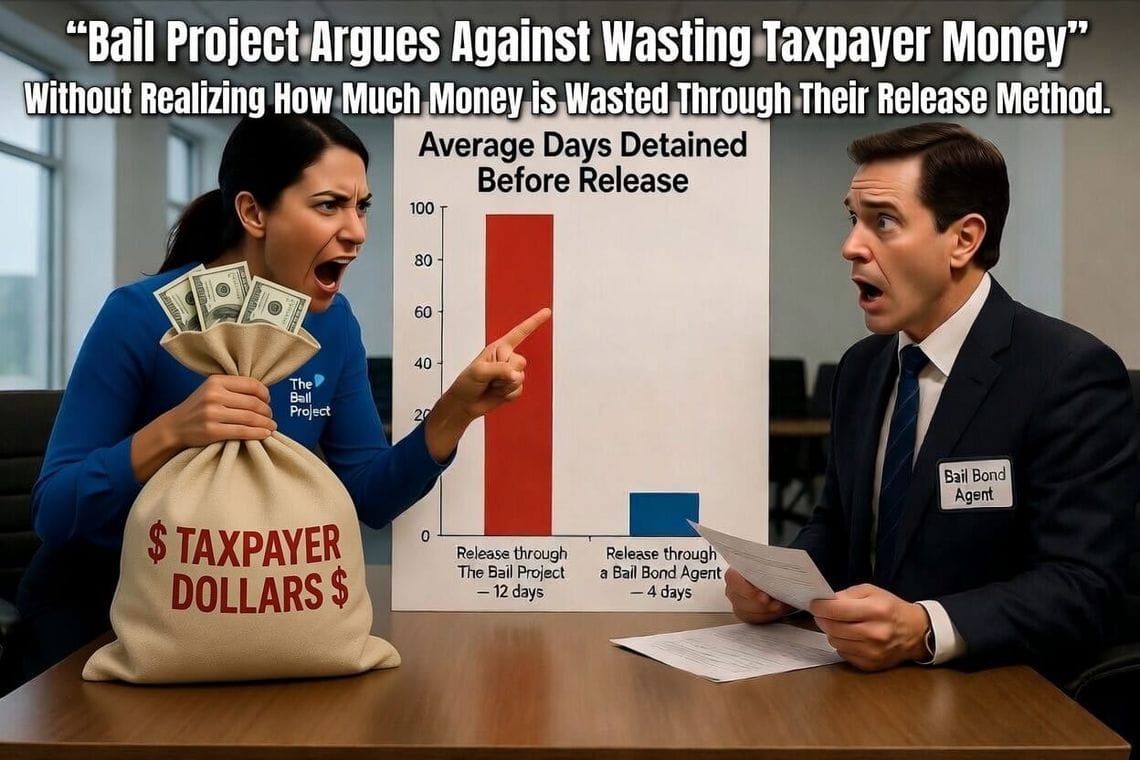
The Bail Project’s Own Data Undermines Its Taxpayer-Savings Claim. Here's a clear, objective summary of the article: Main Claim Being Challenged. The article argues that The Bail Project—a prominent nonprofit that posts bail for people who can't afford it—undermines its own narrative that its model saves taxpayers money. The Bail Project frequently claims the U.S. wastes about $14 billion annually jailing legally innocent (pretrial) people who simply can't pay cash bail, and that their charitable bail funds are a smarter, cost-saving alternative. bailproject.org Key Evidence from The Bail Project's Own Data. The author focuses on The Bail Project's June 2025 report "The False Promise of Bail", which analyzed 3,320 pretrial cases in Tulsa County, Oklahoma.
- Defendants released via The Bail Project spent an average of 12 days in pretrial detention.
- Those released on a traditional surety bond (posted by a licensed, bail bond agent) spent an average of only 4 days.
- People who paid full cash bail to the court also averaged far fewer days detained.
For the 117 people in the study sample whom The Bail Project helped, this difference resulted in over $70,000 in additional local taxpayer costs for that one-year cohort alone. Author's Analysis and Calculations. The article uses Tulsa County's approximate daily jail cost of $78 per inmate to break it down:
- Surety bond client: ~4 days × $78 = $312 in taxpayer jail costs.
- The Bail Project client: ~12 days × $78 = $936 in taxpayer jail costs.
This makes The Bail Project's approach roughly three times more expensive per person in terms of pretrial detention time. The extra 8 days per person, the author notes, represent unnecessary taxpayer expense. The core argument is that speed of release matters most for saving money on pretrial detention. Commercial surety bonds have strong financial incentives (the bondsman loses money if the defendant doesn't appear or is hard to manage), leading to faster processing and release. Charitable bail funds, by contrast, involve more administrative steps, resulting in longer average detention times. Broader Context and Conclusion. The author grants The Bail Project's premise that pretrial jail time is costly and often wasteful, but points out the irony: their own flagship study shows that the people they assist end up spending more time in those costly jail cells than people using the traditional surety system they criticize. The takeaway is that if the goal is truly minimizing taxpayer spending on pretrial detention, commercial surety bonds appear more efficient at quickly releasing people than the nonprofit charitable model. The article frames this as evidence that The Bail Project's taxpayer-savings claims don't hold up under scrutiny of their own data. bail-reform-truth-and-propaganda.ghost.io In short, the piece is a critique from a pro-surety-bond perspective, using The Bail Project's reported numbers to argue that their approach may actually increase (rather than decrease) short-term taxpayer costs related to jail stays. It doesn't deeply address long-term outcomes like court appearance rates or public safety in this article. Read more like this at https://bail-reform-truth-and-propaganda.ghost.io/